Families use Rezilia. Your teams use what it produces: a cohort level read on caregiver load that you can put in front of a CFO, a board or a works council without exposing a single person.
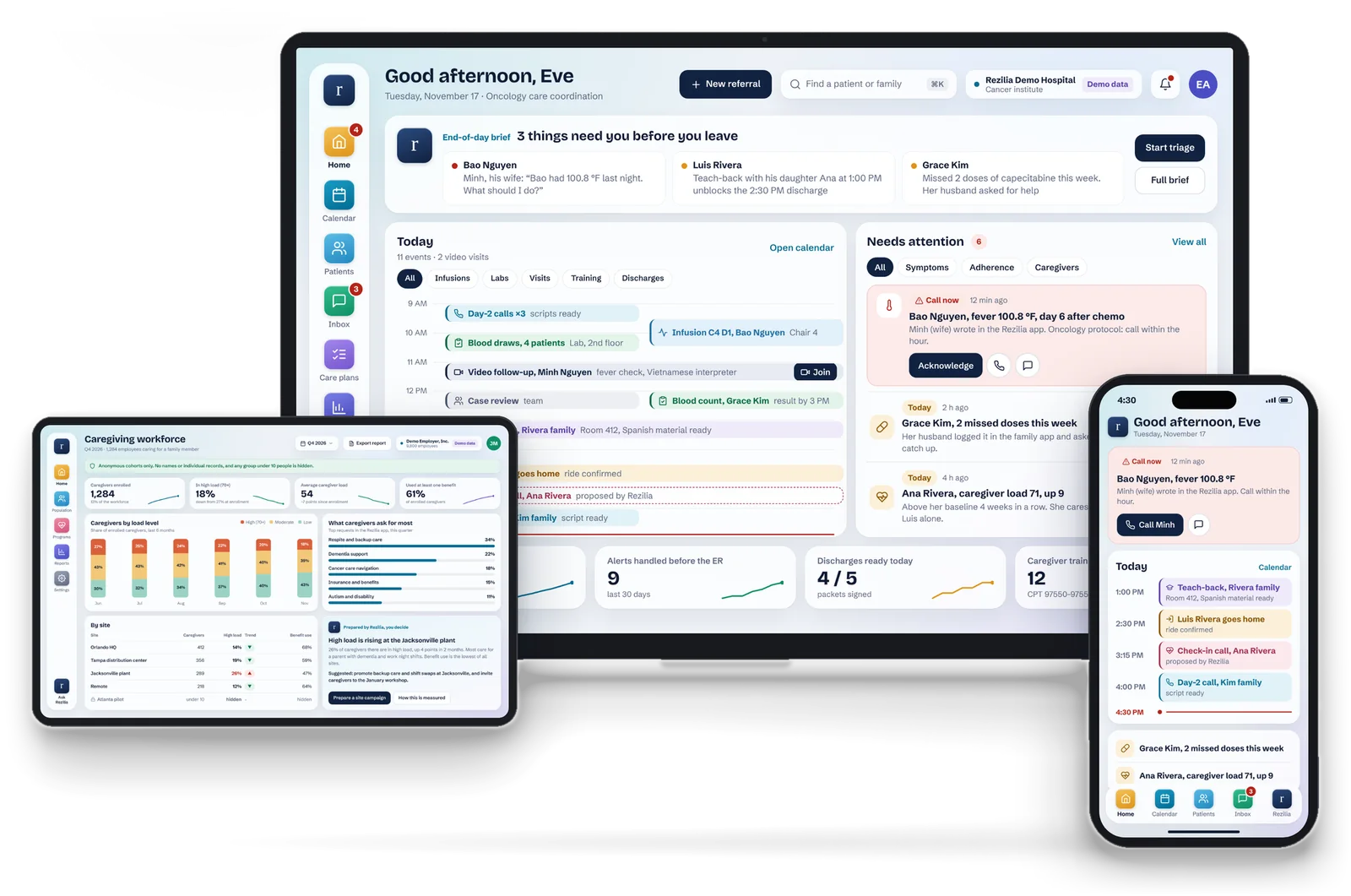
Enrolled families, average load index, share of the cohort in a critical band, and the direction of travel.
Distribution across low, moderate, high and severe, tracked over time rather than sampled once.
Cohort counts by severity, so care management outreach has a reason attached rather than a hunch.
Movement out of high and severe bands, load points reduced, engagement, formatted for reporting.
Break the cohort down by site, business unit or territory when you run more than one.
Exports for funders, boards, benefit renewals and grant applications.
Hospitals and care programs see a family by name only when that family has consented. Employers and insurers receive aggregated, anonymized cohort metrics: no names, no message content, no individual score. Cohorts below a minimum size are suppressed so nobody can be identified by elimination.
This is enforced in the architecture rather than in a settings page, which matters for two reasons. It makes the consent conversation with families simple, and it makes the conversation with a works council or a data protection officer short.
If a vendor can show you one employee’s wellbeing score, walk away from that vendor.
Headcount or cohort, sites, languages, and whether you deploy direct or through a broker.
Comms kit and a launch session. Families activate themselves, you never handle enrollment data.
Usage is driven by the family, not by internal reminders. It spreads because it solves a problem at home.
Around ninety days you get the first anonymized read, then a rhythm you choose.
We answer security and procurement questionnaires directly, and we will do it before contract rather than after.
The five questions that decide whether a deployment happens.
Cohort level distributions of the Cognitive Load Index, with a minimum group size below which nothing is displayed. For employers and insurers: no message content, no individual score, no name. Hospitals and care programs see a family by name only with consent. The family’s account belongs to the family.
Zarit is a validated questionnaire administered at a point in time. The Cognitive Load Index is continuous and passive, computed from how the platform is actually used. They answer different questions, and we designed the index to be readable alongside Zarit rather than instead of it.
Not in production yet. The Connect integration runs in sandbox over FHIR R4, with SSO and secure export. Epic MyChart is already live in the family app. Our integrations page lists the resources and the authentication model in detail.
Yes to both. Our security and privacy page documents the architecture, hosting, encryption and subprocessors, and it is written for a security review rather than for a brochure.
Six to eight weeks for a cohort deployment with no EHR integration, and longer when Epic is in scope. Nonprofit pilots run twelve months at no cost, which is the fastest way to see the data on your own population.
Epic MyChart is live in the Rezilia family app. Rezilia Connect integrates over FHIR R4 in sandbox, with SSO and secure exports. See what is live.
HIPAA architecture on Azure, encryption, hosting, BAAs and subprocessors, plus exactly what your organization never sees. Written for review.
See what employee caregiving costs your company in absenteeism, turnover and lost productivity. Enter five numbers and get your figure.
Forty-five minutes with your team, on your real numbers rather than a canned demo.